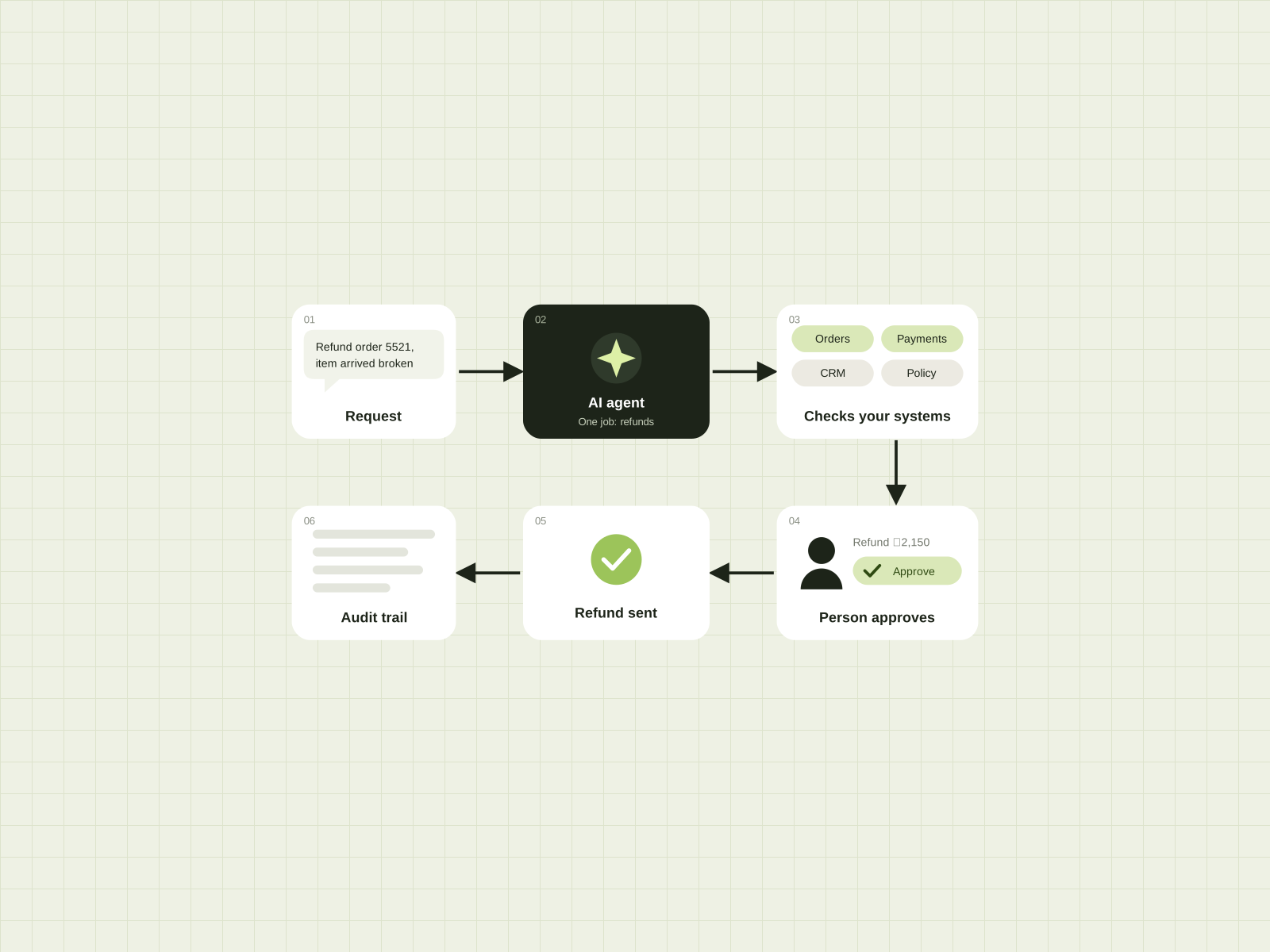
Stuck open, nobody notices
It passes live steam to the drain 24 hours a day. The only symptom is a slightly higher fuel bill across the whole plant.
SteamTrust · Flagship industrial solution
Wireless tags on every steam trap, a ranked repair list every morning, and emissions evidence your auditor can check.
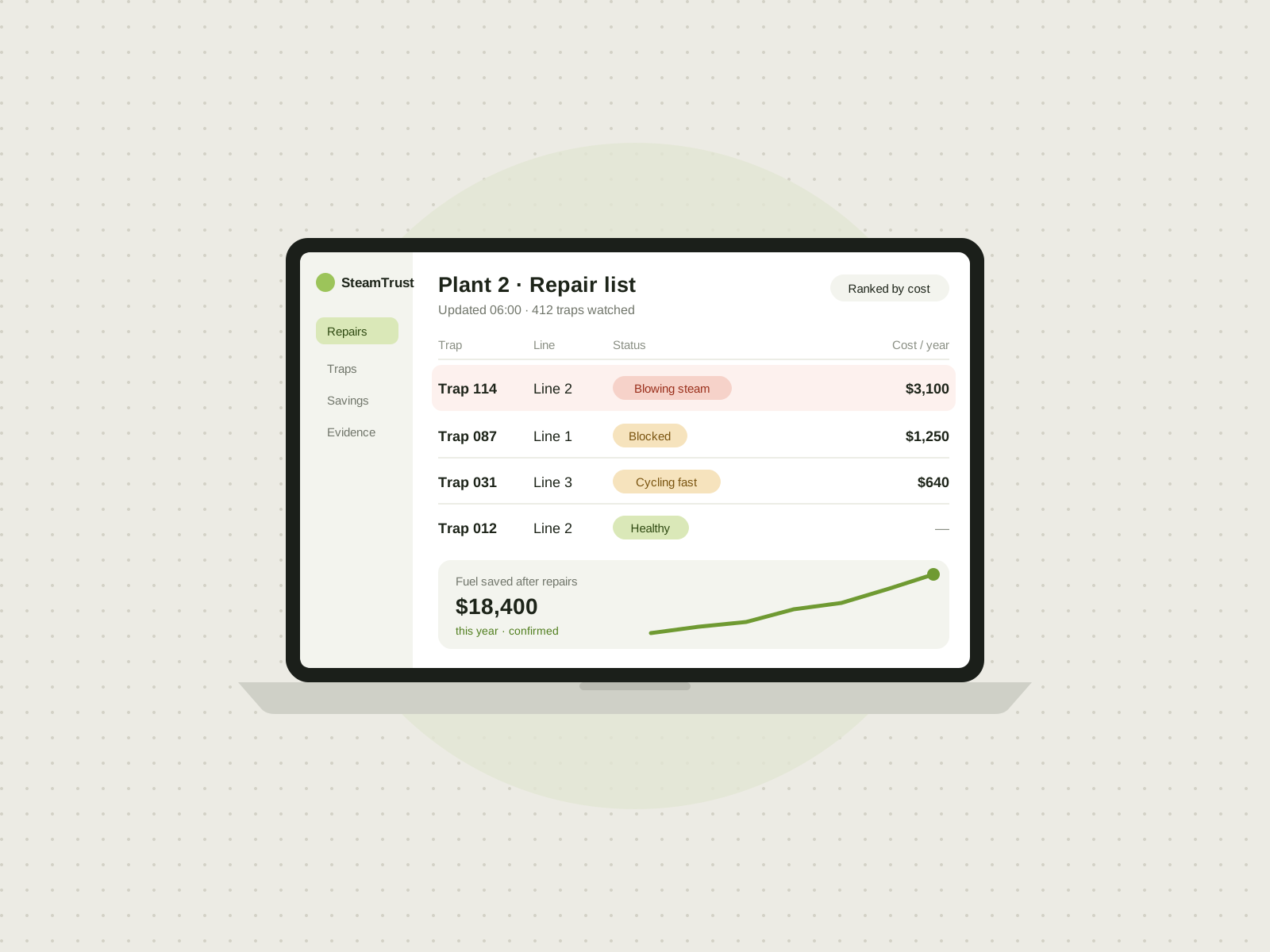 Illustrative interface
Blowing steam, costing about $3,100 a year. Fix first.
Most plants check their traps once a year with a clipboard. The expensive failures don’t make a sound.
It passes live steam to the drain 24 hours a day. The only symptom is a slightly higher fuel bill across the whole plant.
The US Department of Energy benchmark for plants with no formal trap maintenance for three to five years.
With an annual walk-round, the average failure runs for about six months before anyone sees it.
Across Southeast Asia, emissions disclosure, carbon pricing and export buyers are asking for measured figures. An estimate is no longer enough for an auditor.
Lead with the fuel bill. Close with carbon.
Move the sliders. Every figure is computed from published benchmarks and our business-case assumptions, never generated.
Estimate only. Modelled on 144 t of steam a year per failed trap and 55% of the loss recovered once traps are repaired. Your site survey replaces these assumptions.
Get a site surveyA ranked repair list every morning, instead of a yearly walk-round with a clipboard.
A measured, auditable Scope 1 reduction for the published report.
Savings measured continuously after each repair, not claimed once and forgotten.
Off-the-shelf radio hardware, our software, and a hard line on where AI is allowed.
Steam trap
New sensor or an existing signal
Radio tag
LoRaWAN, battery powered
Gateway
On the roof, 4G back-haul
Platform
Classifier and evidence ledger
Dashboard & report
Repair list, PDF and Excel
Tags read each trap’s temperature, or an existing 4–20 mA, Modbus or switch signal, and report every 15 minutes.
A trained model classifies each trap. Below 85% confidence it is marked indeterminate, and no saving is claimed.
Readings and repairs go into a hash-chained evidence ledger. Reports use a versioned method; a language model never writes a number.
We use whatever your plant already has, and fit new sensors only where it has nothing.
Where traps already report over Modbus, one tag reads a dozen of them from the register.
A rail-mounted isolator copies the signal. The original wire carries on to your control system untouched.
Dry contacts on traps that already have them are read directly.
Most traps have no instrumentation, so we clamp a temperature probe on the pipe. No cutting, no rewiring.
We never cut into your control loop. Our system watches and advises; it never switches anything and is not part of any safety system. If our device fails, your plant carries on.
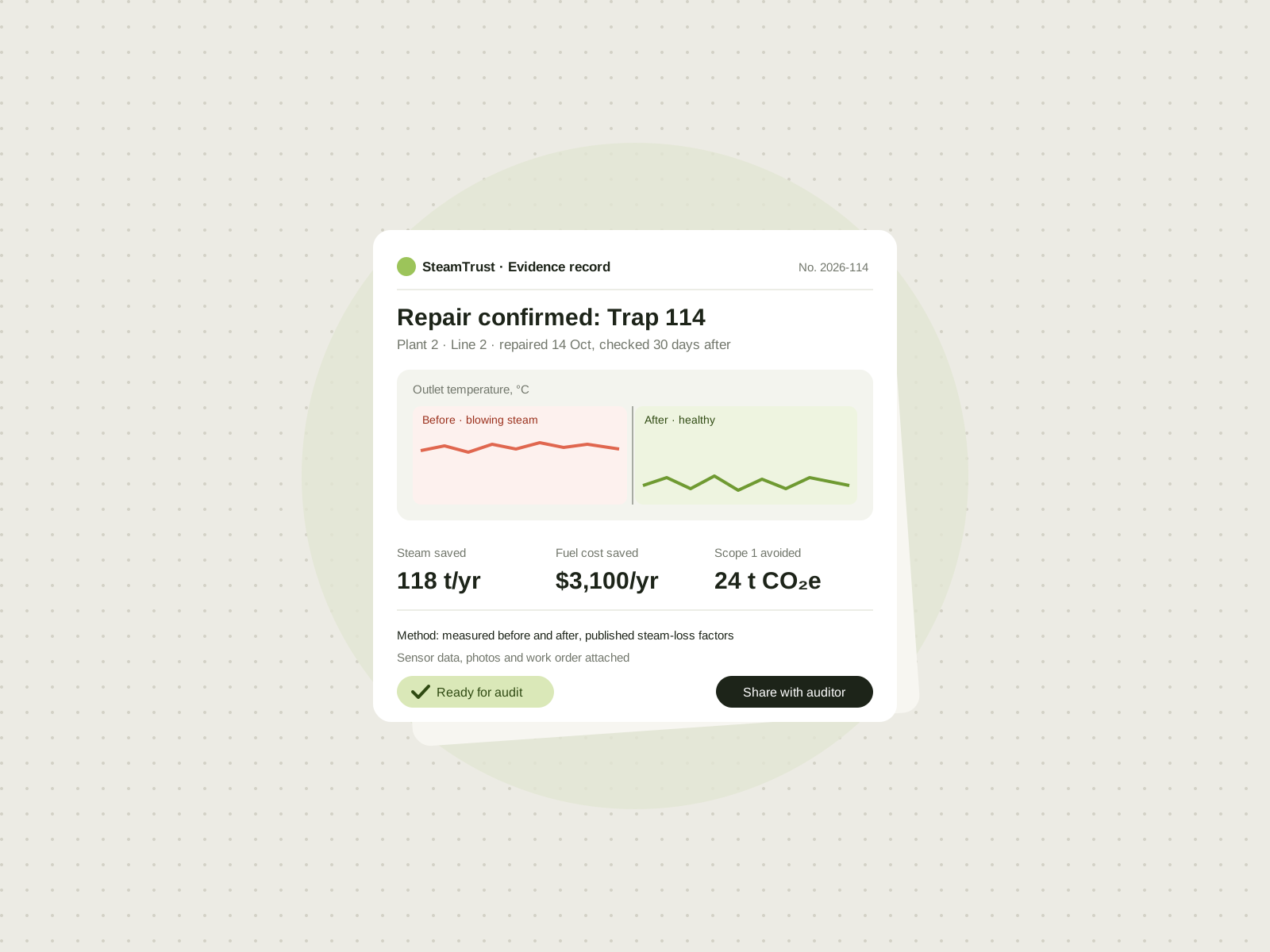
The report your sustainability manager is buying. Conservative by design: it states its uncertainty and never claims a saving before a repair is confirmed.
Continuous monitoring of 248 steam traps identified 43 failed traps. 31 were repaired and confirmed back in normal operation. Verified reduction: 486 tCO₂e.
Scope 1, stationary combustion · GHG Protocol Corporate Standard · ISO 14064-1 · IPMVP Option A
| Step | Method | Result |
|---|---|---|
| Trap condition | Classifier on 15-minute surface temperature; confidence ≥ 0.85 to book a loss | 43 failed of 248 |
| Steam loss | Orifice flow at rated orifice size and measured header pressure | 1,847 t of steam |
| Fuel equivalent | Measured boiler efficiency, feedwater temperature and blowdown | 5,301 GJ |
| Emissions | IPCC 2006 emission factor for natural gas | 486 tCO₂e |
±14% at 95% confidence. The reported figure is the lower bound, not the midpoint.
Raw readings, classifier version, repair confirmations and emission-factor sources, kept 7 years in a hash-chained ledger.
Your boiler’s fuel. A leaking trap makes it burn more, so fixing traps cuts Scope 1 directly.
Steam bought from an industrial-park utility still leaks through your traps. Same fix, different line on the report.
Your export buyers’ Scope 3 includes your Scope 1. That is why their questions now reach your plant.
Both start with a site survey and a quote. We don’t publish prices.
Buy the tags once, then subscribe to the dashboard, alerts and reports. Our cloud, updated continuously.
Own the software on your own servers, with yearly maintenance. For data-residency and no-cloud IT policies.
Quotes follow a short site survey of your trap count, existing instrumentation and radio coverage.
Straight answers, including the ones where the answer is “not yet”.
Start with your work email. The enquiry form takes about two minutes.
Takes you to a short enquiry form. No newsletter, no spam.
Connect. Automate. Transform.